
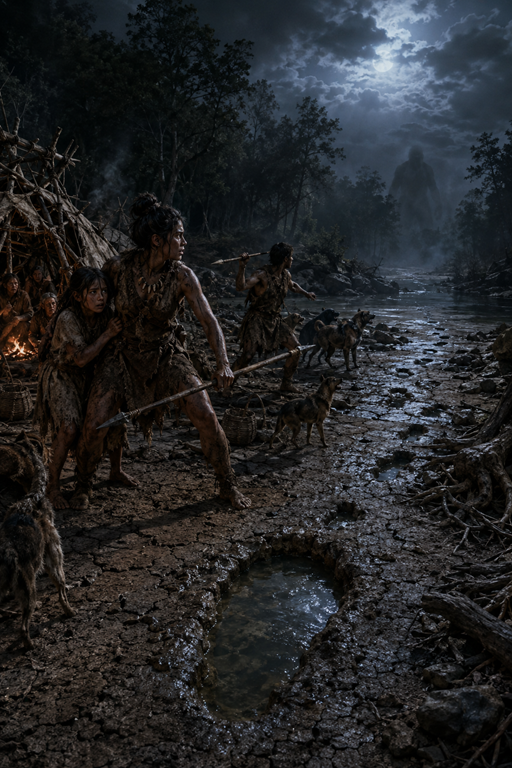
Chapter 1 - Three Waters
Asha smelled the river before she saw it.
The scent came through the trees in cool breaths: mud, wet stone, rotting leaves, and the faint sharpness of fish scales drying in the sun. After six days crossing the yellow grasslands, the smell should have brought relief. The children should have run ahead. The hunters should have called to one another about where they would place the weirs.
Instead, the people walked in silence.
The river was too quiet.
Asha shifted the rolled sleeping hides on her shoulder and listened for the familiar rush of the spring runs. Every warm season her people returned to the place where two cold streams joined the larger river. The eastern spring usually announced itself long before the camp came into view, chattering over limestone shelves and tumbling through roots. The western run was deeper and slower, but its water could still be heard moving beneath the alder branches.
Today, Asha heard only insects.
Behind her, someone’s carrying frame creaked. A baby fussed against its mother’s chest. Bare feet whispered over dry leaves.
Renn came back along the trail, ducking beneath a low branch. He had gone ahead with two other hunters to make certain no rival band had claimed the camp.
His expression told Asha the place was empty.
It did not tell her the place was safe.
“Well?” called Vara, who walked near the front with a digging stick in one hand and a bundle of firewood strapped across her back.
“No people,” Renn said.
Several shoulders loosened.
“No fresh hearths,” he continued. “No cut branches. No bones split for marrow.”
“That is good,” Vara said.
Renn glanced at Asha before answering.
“The water is low.”
The others began walking again. Asha remained where she was until Renn drew beside her.
“How low?” she asked.
“Lower than I have seen it.”
“That is not an answer.”
He wiped sweat from his brow with the back of his wrist. Renn was eighteen summers old, broadening through the shoulders but not yet carrying the heaviness of the older hunters. A pale scar curved beneath his left eye where a boar’s tusk had opened his cheek two winters before.
“The eastern run has become three narrow streams,” he said. “The western spring barely reaches the river. There are stones exposed that should be beneath water.”
“Anything else?”
Renn looked toward the trees ahead.
“Come see.”
Asha followed him down the last slope.
Three Waters lay within a wide bend of the river, protected on three sides by limestone ridges and thick woodland. The seasonal camp had been used by Asha’s people since before her grandmother’s grandmother had been born. Old hearth circles marked the high ground. Postholes from previous shelters remained beneath mats of leaves. Willow frames for drying fish leaned against trees where they had been stored the year before.
The place should have felt like returning to a second home.
Instead, Asha had the sensation that someone had moved everything slightly while they were gone.
The river had withdrawn from both banks, leaving broad strips of cracked mud. Stones normally hidden beneath the current shone in the afternoon light. The two spring runs no longer entered the river as full streams. They wandered through the exposed ground in thin silver channels, separating and joining as they searched for the lowest paths.
Children hurried past Asha toward the bank.
“Stay above the mud,” Vara warned.
One boy immediately stepped into it.
His mother seized the back of his hide tunic and hauled him out before the muck swallowed his ankle. The other children laughed, but the sound faded quickly.
Across the river, roots hung from the wooded bank like exposed fingers.
Asha lowered the sleeping hides from her shoulder.
The eastern spring had carved a deeper course since the last warm season. Its old channel remained visible as a pale scar, but the water had abandoned it and now slipped between two slabs of limestone farther north. The new run disappeared beneath the edge of one shelf and emerged several body lengths away.
She crouched beside it.
The water was clear and cold. Small fish held themselves motionless in the current. Nothing about the stream appeared wrong except its path.
Asha pressed her fingers into the mud. Damp beneath the surface. No rain had fallen for many days, but water still moved below the ground.
“The drought opened it,” Renn said.
“Perhaps.”
“You do not believe that?”
“I believe the water has found a place we did not know was there.”
“That is what I said.”
Asha looked up at him.
Renn smiled briefly. “Almost what I said.”
Vara began directing the placement of shelters. Families carried poles toward the high ground. Two hunters inspected the old smoking pit. Others gathered stones for hearths and cleared leaves from sleeping places.
The familiar labor eased the people’s unease. Soon bone pegs were being driven into the earth. Hides stretched over bent saplings. Children searched the shallows for mussels while watched by their older sisters.
Asha continued along the spring.
The limestone shelves near the source had changed most. Water had once covered them to the height of her knees. Now the exposed rock formed a broken white terrace beneath the trees. Cracks ran through its surface. Some were narrow enough to cover with one finger. Others opened into darkness.
She placed her ear near the widest crack.
Water moved below.
It was not the soft trickle of a hidden stream. It sounded deeper, as though a river ran beneath the stone.
“Asha.”
She turned.
Luma stood at the edge of the trees holding two bundles of reeds. She was twelve summers old and thin from the winter sickness that had taken her father. Her dark hair had been tied back with a strip of rabbit hide, but loose strands clung to her cheeks.
“You should not be carrying both,” Asha said.
“Mother told me to bring them.”
“She did not tell you to bring them at the same time.”
Luma dropped one bundle beside the shelter site. “You sound like her.”
“Someone must.”
For an instant, Luma almost smiled.
Then she looked past Asha toward the wooded bank.
“What is it?” Asha asked.
“Nothing.”
Asha followed her gaze. Alders leaned over the western spring, their leaves trembling though the air was still.
“You saw something?”
“No.”
“Then what did you hear?”
Luma tightened her grip on the reeds.
Before she could answer, Renn called from downstream.
“Asha!”
There was urgency in his voice, but not fear.
Not yet.
Asha crossed the exposed riverbank. Renn stood near the western run with Vara and two hunters. All four stared at the mud.
“What did you find?” Asha asked.
Renn pointed.
The footprint lay where a shallow branch of the spring crossed the bank.
At first, Asha thought it belonged to a bear.
The impression was wider than both her hands placed side by side. Water filled its deepest portions, making the edges shine. Five long marks extended from the front. They resembled toes, but each ended in a narrow point pressed deeply into the mud.
Asha crouched.
The rear of the print was rounded like a human heel.
Vara made a sound in her throat.
“Bear,” said Tovin, the oldest of the hunters.
“Bears do not have heels like men,” Renn replied.
“A large bear can leave a strange print when the back foot comes down upon the front.”
“Then there would be other tracks.”
The hunters looked around.
The mud stretched smooth and undisturbed in every direction.
No trail approached the footprint.
No trail continued from it.
There was only the single enormous impression filled with clear water.
Asha studied the edges. The surrounding mud had already begun to dry beneath the sun, but the footprint remained wet. A thin stream ran from one toe mark into another.
She touched the water.
Cold.
Colder than the river.
“Perhaps the ground collapsed,” Tovin said.
“In the shape of a foot?” Renn asked.
“Water makes shapes. Mud makes shapes. Men see what they expect.”
“I did not expect this.”
Vara used her digging stick to test the ground near the print. The mud held firm.
“Do not step closer,” Asha said.
“I know where to place my feet.”
“We do not know what lies beneath them.”
Vara stopped.
Asha looked toward the western spring. Its reduced channel passed between roots and vanished under the wooded bank. Limestone showed through the water in pale broken ridges.
“Where were you when you saw it?” she asked Renn.
“On the higher ground.”
“You did not walk near it?”
“No.”
“Did you hear anything?”
“Only the spring.”
The water in the footprint trembled.
Everyone saw it.
Renn stepped back.
Asha held still.
A second ripple crossed the surface, though no wind reached the sheltered bank. The water rose almost to the edge of the impression, then settled.
Tovin cleared his throat. “Something moved beneath the mud.”
“Then we should not build near it,” Vara said.
She turned toward the camp.
“No one sleeps beside the western run,” she called. “Move the shelters uphill.”
Several people protested. The higher ground was harder and farther from the water, but Vara silenced them with a look.
Tovin remained beside the print.
“Should we fill it?” he asked.
“With what?” Renn said.
“Stones.”
Asha stood.
“No.”
The hunter frowned. “Why leave it?”
“Because I want to know whether it changes.”
“Changes into what?”
Asha had no answer.
By late afternoon, smoke rose from four hearths. Fish traps were repaired and placed in the river’s narrowed channel. Women dug for roots in the damp soil near the eastern run. Children collected driftwood from the exposed banks.
The footprint remained where Renn had discovered it.
Asha checked it whenever her work brought her near.
The water never evaporated.
The sun passed above the trees. Mud hardened around the print and split into curling plates. The enormous impression stayed dark, smooth, and wet.
Once, Asha thought she saw something pale move beneath the surface.
She leaned closer.
Only her own reflection looked back.
Luma avoided the river.
She gathered firewood beneath the trees, helped her mother stretch their shelter hide, and sorted dried berries into woven bowls. Each time someone sent her for water, she found another task.
Asha noticed.
Near sunset, she carried two skin bags to the eastern spring and found Luma kneeling behind a fallen log. The girl was not crying, but she held herself with the rigid stillness of someone refusing to begin.
Asha set down the bags.
“Tell me.”
Luma looked toward the camp. “Mother will say I dreamed it.”
“Were you asleep?”
“No.”
“Then you did not dream it.”
The girl ran her thumbnail along a crack in the log’s bark.
“When we first arrived, I heard someone across the water.”
“What did they say?”
“My name.”
“Who?”
Luma’s lips pressed together.
Asha waited.
“My father.”
The words entered the space between them softly.
Asha sat on the log.
Luma’s father, Sovan, had died during the last cold moon. Fever had burned through him for four days. Near the end, he had mistaken Luma for her mother and begged her to open a shelter door that did not exist.
Asha had helped carry his body to the burial hollow.
“You know it could not have been him,” she said.
“I know.”
“Where did the voice come from?”
“The wooded bank beyond the western spring.”
“What exactly did it say?”
Luma closed her eyes.
“Little ember.”
Asha felt the skin tighten along her arms.
Sovan had called his daughter that since she was small. He said she had come into the world angry and red, with fists clenched as though ready to strike the winter itself.
Others had heard him use the name, but not often.
“Did it say anything else?” Asha asked.
“It told me to come across.”
“How?”
“It said there was a dry place beneath the roots.”
Asha looked through the trees toward the river.
“Did you see anyone?”
“No.”
“Did the voice sound far away?”
Luma shook her head.
“It sounded as though he was beside me.”
Asha picked up one of the skin bags.
“You will not go near the western bank alone.”
“I was not going to.”
“You will not answer the voice.”
“I know it was not him.”
“Knowing is not the same as refusing.”
Luma looked at her.
Asha softened her voice. “Grief can make a path where there is none. Do not step upon it.”
The girl nodded.
They filled the bags together at the eastern spring.
As Asha knelt, she studied the new cracks in the limestone. Air moved from one of them, faint and cool against her wet fingers.
It carried a smell she could not place.
Not rot.
Not exactly.
Something old and trapped.
The evening meal was eaten beneath a sky turning the color of bruised fruit. People shared roasted fish, dried venison, bitter roots, and the last handfuls of summer berries. The children recovered their laughter. Hunters argued over where deer might cross the river. Vara discussed sending scouts downstream at first light.
No one spoke openly of the footprint.
Its presence remained in every silence.
When darkness settled, the community fires appeared brighter than usual. Families placed their shelters close together on the high ground. Dogs that normally wandered the bank lay near the hearths with their noses pointed toward the water.
Asha sat beside Renn, repairing a torn carrying strap with sinew.
“You told Luma to avoid the western run,” he said.
“Yes.”
“Why?”
“She heard a voice.”
Renn’s hands stopped moving over the dart shaft he was smoothing.
“Whose voice?”
“Her father’s.”
He glanced toward Luma’s shelter.
“Could someone have been teasing her?”
“No one who wished to keep all their teeth.”
“I did not say it was wise.”
Asha pulled the sinew tight. “The voice knew what her father called her.”
Renn stared into the fire.
The others around them spoke in low voices. A woman sang to a restless baby. Someone cracked a fish bone between two stones.
Renn said, “My grandmother told a story about this place.”
“Your grandmother told stories about every place.”
“She said people once lived beneath the springs.”
“Otters?”
“People.”
“Then she was trying to frighten you away from the water.”
“It worked.”
Asha looked at him. “You have walked into rivers during floods.”
“Rivers do not pretend to be my dead relatives.”
A log collapsed in the hearth. Sparks rose and vanished.
“Tell me the story,” she said.
Renn set the dart shaft across his knees.
“She said a band lived here before our people began returning. They left in the middle of a warm season. They abandoned tools, hides, even stored meat.”
“Why?”
“She did not know. In one telling, sickness came from the spring. In another, a man killed his family and became a bear.”
“Those are not the same story.”
“They are when my grandmother tells them.”
Asha examined his face.
“What else?”
Renn lowered his voice.
“She said you should never follow a familiar voice into unfamiliar darkness.”
Asha looked toward the western trees.
Luma sat with her mother near the largest fire. The girl appeared to be listening to a story told by one of the elders, but her eyes remained fixed on the river.
The moon rose late.
Clouds moved across the stars, leaving the camp in alternating silver and darkness. One by one, the fires sank into beds of red coals. People withdrew beneath their shelters. The dogs curled together near the center of the camp.
Asha lay awake.
She could hear Renn breathing in the shelter beside hers. Her mother slept on the other side of the hide wall, murmuring whenever she shifted. Farther away, someone snored with the steady rhythm of a stone scraper.
Beyond the shelters, the river moved softly.
The sound should have been comforting.
It was not.
Asha closed her eyes.
Stone struck stone.
The sharp crack came from the trees beside the western spring.
Asha opened her eyes.
For several heartbeats, there was silence.
Then the stones struck again.
Two blows.
A pause.
One blow.
A longer pause.
Two more.
Asha’s body went cold.
Every hunter among her people knew the signal.
Two stones struck in that pattern meant, Come alone.
It was used when someone discovered wounded game, a dangerous animal, or strangers whose presence should not be announced to the entire camp. The signal carried farther than a whisper but could be mistaken for ordinary work by anyone unfamiliar with its rhythm.
Stone struck stone again.
The imitation was perfect.
Asha slipped from beneath her sleeping hide.
Renn was already crawling from his shelter, holding a dart.
“You heard it?” she whispered.
He nodded.
“Who is on watch?”
“Tovin and Marek.”
“Where?”
“Southern trail.”
The signal came from the western bank again.
Come alone.
Asha scanned the camp.
No one else had emerged. The people slept beneath low hide roofs, unaware of the invitation moving through the darkness.
“Stay here,” Renn said.
“That is what the signal wants.”
“It may be one of our hunters.”
“Neither should be across the western spring.”
Renn’s jaw tightened.
Asha took a burning branch from the nearest hearth. The end glowed but did not flame. She wrapped dry grass around it and blew until a small tongue of fire appeared.
A shelter hide rustled behind her.
Luma stepped into the open.
She was barefoot and carried no weapon.
“Go back,” Asha whispered.
Luma did not look at her.
Her face was turned toward the trees.
Stone struck stone.
The girl took one step toward the river.
Asha caught her wrist.
Luma jerked as though waking.
“He is there,” she said.
“No.”
“He knows the signal.”
“Your father was not a hunter.”
“He learned it.”
“When?”
Luma’s mouth opened.
No answer came.
Across the camp, one of the dogs lifted its head. A low growl moved through its chest. The other dogs woke and turned toward the western run.
Renn raised his dart.
The signal sounded again.
Not from the woods.
From beneath the ground.
The sharp knocks traveled through the limestone under Asha’s feet. She felt each blow in her ankles.
Two.
One.
Two.
Come alone.
The dogs began barking.
People stirred inside the shelters. Vara called out, asking what had happened.
The sound beneath the earth stopped.
For one breath, the entire camp held still.
Then a man’s voice spoke from the wooded bank.
“Little ember.”
Luma pulled against Asha’s grip.
The voice was gentle. Tired. Loving.
It sounded close enough to belong to someone standing just beyond the firelight.
“Little ember,” it called again. “I found the dry place.”
Luma made a broken sound.
Asha wrapped both arms around her.
Renn stepped between them and the river.
“Show yourself,” he shouted.
The dogs barked harder.
Something moved beneath the trees.
A branch bent. Leaves shivered. A dark shape passed between two trunks, tall enough that its shoulders seemed level with the lowest limbs.
Renn drew back his throwing arm.
The figure stopped.
For an instant, the clouds uncovered the moon.
Pale light crossed the western bank.
No one stood beneath the trees.
Only roots, stone, and the narrow spring channel were visible.
Then the moonlight reached the mud where the enormous footprint had been.
The print was gone.
In its place lay a trail of wet impressions.
They began at the water’s edge.
They crossed the hardened bank.
They ended at the edge of the camp.
Asha looked down.
A final footprint filled slowly with clear water less than one body length from where Luma stood.
Beneath the earth, two stones struck together.
Once.
Twice.
Then something under the limestone began to crawl toward them.