
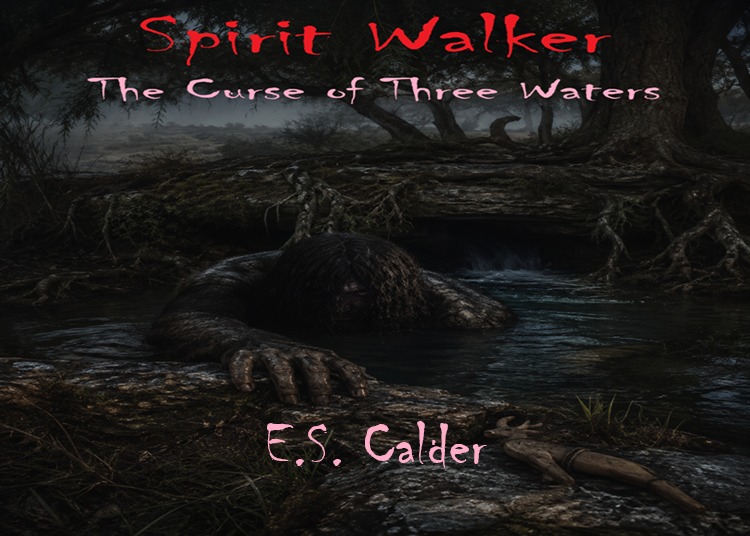
Spirit Walker - The Curse of Three Waters
Prologue: The Name He Threw Away
The country of Three Waters, about 6000 BCE
The spring returned Sena’s blood before it returned her body.
Nari saw it at first light, a red thread unwinding beneath the clear water where the spring rose from the limestone. It curled between the pale stones, vanished beneath a shelf, then appeared again farther down the run. No cloud of mud surrounded it. No wounded deer thrashed in the shallows. The water remained so clear that Nari could count the tiny fish holding themselves against the current.
She crouched and touched two fingers to the red.
The blood was fresh enough to stain the whorls of her skin.
Behind her, Three Waters awakened. Someone fed wood to the central fire. A child complained about the cold. Stone struck stone as hunters checked the edges of their dart points. The small sounds of morning carried through the trees, ordinary and precious.
Sena should have been among them.
Nari’s daughter had left before dawn with her seven-year-old son, Pell, to gather bark from the willows downstream. She had taken a woven basket, a flake knife, and nothing else. The boy had carried a little deer carved from river wood. He carried it everywhere, even when he slept.
Nari had found the deer lying on the bank.
One wooden leg was dark with blood.
She stood and studied the ground without calling for help. The sand beside the spring held Sena’s prints and the smaller marks of Pell’s feet. Both trails approached the water. Neither continued along the opposite bank.
There was another print beneath them.
A man’s heel had pressed deeply into the mud and twisted toward the limestone rise. Someone had rubbed at the mark with a leafy branch, blurring the toes and sweeping away the tracks that followed. He had worked carefully but not carefully enough.
Nari knew the people of Three Waters by their feet as readily as she knew them by their faces. Renn favored his left leg after a bison had rolled across it. Old Haru’s toes bent inward. Sena walked lightly upon the outside edges of her feet.
The hidden heel belonged to Korr.
A jay cried from the woodway. Nari lifted her head.
Korr emerged between the trees.
He carried three hunting darts in one hand and a bloodied length of hide in the other. He was the tallest man among the people, broad through the shoulders, admired for the strength with which he cast a dart. A new stone knife hung at his waist. The blade was dark gray, almost blue, and longer than any stone found near Three Waters.
“Nari.” He used the soft voice people expected in the presence of a Medicine Keeper. “Come away from the water.”
She looked at the bloody hide. “Where are they?”
Korr glanced toward the sleeping shelters. “Call the hunters.”
“Where are my daughter and her child?”
“The grass people took them.”
The people who camped beyond the eastern prairie had traded dried berries and red stone with them two summers earlier. There had been arguments over hunting ground and water, but no blood between the groups.
Korr held up the hide. A pattern had been scratched into its surface: three crossing lines used by the eastern people when marking bundles. Blood soaked one corner.
“I found this beyond the willow bend,” he said. “There were many tracks. Sena fought them. I followed until they reached open ground.”
“You followed them alone?”
“There was no time to wake men who sleep while children are stolen.”
The reproach was meant to sound like courage. It sounded rehearsed.
People gathered behind Nari. Korr raised the bloodied hide so all could see. Fear traveled through them in murmurs. Men reached for darts. A mother pulled her two children close.
“They have tested us,” Korr announced. “If we do nothing, they will return for another child. We must cross the prairie before the sun is high.”
The words moved quickly through the gathering. Grief wanted an enemy. Fear wanted a direction in which to run.
Nari looked down at Korr’s feet.
His ankles were wet.
The willow bend lay downstream along a dry trail. A man returning from there had no reason to enter water above his knees. Yet Korr’s hide leggings clung darkly to his calves, and a strand of pale waterweed had caught beneath the cord around his right ankle.
The same weed grew only inside the spring cavern.
Nari lifted her gaze to the new knife at his waist.
“Where did you get that blade?”
His hand settled over its handle. “I traded for it.”
“From whom?”
“A traveler.”
“The traveler who vanished after sharing our fire?”
Something changed behind Korr’s eyes. It lasted no longer than the flicker of sunlight on moving water, but Nari saw it.
Then he smiled.
“Your daughter is missing,” he said. “And you question me about stone?”
He turned to the hunters. “Gather your weapons.”
“No one leaves,” Nari said.
Silence spread outward from her.
Korr’s smile disappeared. “Every moment gives them greater distance.”
“No one crosses the prairie until I have followed the blood.”
“The blood leads east.”
“It leads into the spring.”
For the first time, Korr looked toward the red thread in the water.
Nari saw recognition. Not surprise. Recognition.
He stepped between her and the spring. “Grief has confused you.”
“Then grief will have to guide me.”
She picked up Pell’s carved deer and entered the water.
The spring was cold enough to ache inside her bones. It rose to her ankles, her knees, and then her thighs as she followed the red current toward the limestone shelf. Behind her, people whispered. Korr told them again about the tracks he had seen. He spoke loudly now, making his story larger each time he repeated it.
Nari placed her palm against the bluff. Water issued from a low black opening beneath an overhang of roots. In wetter seasons, the passage lay completely submerged. The drought had lowered it enough for a person to crawl inside.
She knelt.
The mud beneath the overhang bore the parallel grooves of knees and elbows. Someone had entered recently while dragging something heavy.
Nari slipped Pell’s carving into the pouch at her waist.
“Bring fire,” she said.
No one moved.
Korr laughed once. “You mean to crawl beneath the earth while your family is carried away?”
Nari looked back at him. “If they are east of us, you have nothing to fear from what I find here.”
Korr’s jaw tightened.
Old Eda came forward with a burning branch. She was too old to hunt but too stubborn to be commanded by fear. She wrapped dry grass around one end and blew until the flame steadied.
“I will hold it,” she said.
Nari took the torch. Several hunters started toward her, but Korr barred their way with one extended arm.
“Let her go,” he said. “The Keeper has chosen to trust mud over men.”
Nari lowered herself into the opening.
The passage scraped her shoulders. Cold water pushed against her from the darkness, carrying the mineral smell of buried stone. She crawled with the torch held before her, its smoke rolling along the ceiling and stinging her eyes.
The tunnel descended, widened, and opened suddenly into a chamber.
Nari stood.
Her flame revealed the dead.
They occupied the ledges above the underground stream, some little more than scattered bone beneath rotted hide, others recent enough to retain the shapes of human beings. Tools and ornaments had been sorted into careful piles. Bundles of dried meat rested upon a stone shelf. Three rare blades lay side by side. Bracelets, pendants, darts, woven cords, and small personal objects filled cracks in the wall.
The missing traveler’s empty pack lay at Nari’s feet.
Farther inside, someone drew a breath.
“Mother?”
Nari turned so quickly that fire scattered from the torch.
Sena lay beyond the stream with one arm curled around Pell. Her hair was wet. Blood covered the front of her hide wrap. The boy’s face rested against her chest, peaceful as sleep except for the bruising around his throat.
Nari crossed the water and dropped beside them.
Sena’s eyes found hers. “I kept him warm.”
Nari touched Pell’s cheek. The flesh had already cooled.
“You kept him warm,” she said.
“He was afraid of the dark.”
“I know.”
Nari pressed both hands over the wound below Sena’s ribs. Blood rose between her fingers.
“Korr,” Sena whispered.
“I know.”
“He said they would blame the grass people. He said they would kill one another, and no one would search here.”
Nari bent until her forehead touched her daughter’s.
“He kept things,” Sena said. “From all of them.”
“Save your breath.”
“He likes remembering.”
Sena’s hand closed weakly around Nari’s wrist. “Do not let him become a story about someone else.”
The grip relaxed.
Nari remained bent over her until the final breath left Sena’s body. She heard the underground water moving around the stones. She heard the torch consuming its grass. She heard something heavier enter the passage behind her.
Korr stepped into the chamber.
He had removed his darts. The long gray knife rested in his hand.
“I told them you would need help,” he said.
Nari covered Sena’s face with the edge of her wrap.
“How many?” she asked.
Korr looked around the chamber. “I do not remember.”
“She said you liked remembering.”
“Things are worth remembering.” His gaze settled upon the piles of tools. “People pass. A good blade remains useful.”
“Pell had no blade.”
“He saw me.”
The simplicity of the answer hollowed something inside her. Until then, a buried part of Nari had expected shame to emerge when Korr no longer needed to lie. Instead, he appeared relieved. The performance had ended. He could stand openly among his dead.
“You killed your companion during the winter crossing,” she said.
“He had broken his leg. I saved the meat he would have eaten.”
“The traveler.”
Korr raised the gray knife. “He would not trade.”
“The family found beside the eastern trail.”
“They saw the knife.”
“And Dura, who challenged your account?”
“He would have divided the people.”
Nari looked at Sena and Pell. “What wrong did they commit?”
Korr’s expression hardened. “Your daughter followed me. She crept behind me like a thief and found what was mine. She forced me to choose.”
“You believe every death is chosen by the person you kill.”
“Weak people create the moment of their own ending.”
“And strong people?”
“Decide what the moment means.”
Korr moved nearer. Water curled around his ankles.
“The others are ready to cross the prairie,” he continued. “By midday, blood will answer blood. When they return, they will find that grief overcame you in the cavern. I will mourn you. I may even sing your name.”
Nari stood slowly. Her hands were red to the wrists.
“No,” she said. “You will not speak my name.”
Korr came at her.
She flung the torch into his face.
He raised an arm against the sparks, and Nari drove her shoulder into his chest. He struck the wall but did not fall. His hand caught her hair. Pain tore across her scalp as he dragged her backward.
Nari seized a fistful of gray ash from the fallen torch and ground it into the blood on her palm.
Korr pulled her head back, exposing her throat.
She smeared the mixture across his face.
He shouted and released her. The sound was anger, not pain, but the cavern answered it. His voice returned from the walls in broken pieces.
Nari dropped beside the stream and filled her bloody hand with water. Red opened across the surface. She reached into the pouch at her waist, took the red ochre used for marking the dead, and crushed it between her fingers.
Blood. Ash. Ochre. Water.
Life taken. Warmth extinguished. Memory of the earth. The spring that had hidden everything.
Korr wiped his face and stared at the red-black stain upon his hand.
“What have you done?”
Nari rose between him and the bodies.
“Nothing that was not already inside you.”
She pressed her palm against his chest.
“You hunted people as though they were animals. You hid your face while others carried your shame. Now the world will see the thing you have always been.”
Korr stabbed her.
The gray blade entered below her ribs. Nari felt the stone scrape bone before he tore it free.
She remained standing.
Korr looked at the blood on his knife and then at her, uncertain for the first time.
Nari closed both hands around his wrist.
“You walked among the people while hiding the beast within you,” she said. “Now you will walk outside the people, and the beast will be all they see.”
Something moved beneath his skin.
Korr looked down.
The muscles in his forearm tightened. His fingers spread until the joints cracked. The gray knife slipped from his hand and struck the stone.
He bent forward with a gasp.
His spine rose beneath the hide across his back, each knob pressing outward. A sound like green wood splitting traveled through the cavern. Korr dropped to one knee, then both. His arms lengthened until his hands reached the ground.
“Stop it.”
Nari pressed one hand against her wound.
“Only one who carries no shadow can return the name you threw away.”
Korr’s head snapped toward her. Hope entered his face even as the bones began to change it.
He believed she had offered escape.
That was his nature. Even now, he heard only the words that might serve him.
“Who?” he demanded. “Who carries no shadow?”
His jaw cracked. The final word stretched into a broken animal cry.
Nari picked up the gray knife.
Korr reached for her, but his new arm carried him farther than he expected. His hand struck the stream. The water convulsed around it and climbed his wrist like something recognizing its master.
Coarse black hair pushed through his skin.
Nari backed toward the passage. Every movement sent heat through her side. She could no longer feel her left hand.
Korr followed on all fours, half man and half an unfinished thing. His shoulders scraped both walls. His eyes remained unchanged. They watched her with the same measuring intelligence that had judged the value of every life in the cavern.
He lunged.
Nari drove the gray knife into the meat of his shoulder.
Korr screamed. The cavern shook with it. Water surged over the ledge, throwing Nari into the passage. She held the knife until the current twisted it from her grasp. It remained buried in Korr as darkness swallowed him.
Nari crawled toward daylight.
Hands seized her beneath the arms and pulled her from the spring mouth. Old Eda pressed hide against the wound. The hunters stared at the blood, waiting for the name of an enemy.
Nari gave them one.
“Korr.”
He roared beneath the earth.
Every person beside the spring heard it.
The sound silenced talk of crossing the prairie.
They carried Sena and Pell from the cavern before sunset. Then they brought out the older dead, one by one, while Nari named what Korr had done. The people listened. Some wept. Some struck their own faces in shame for having believed him. None entered far enough to retrieve the gray knife.
For three nights, Korr changed beneath Three Waters.
On the first night, his screams still formed words. He begged for help. He promised meat, protection, and every treasure he had taken. He called each person by name and reminded them of favors he had done.
No one answered.
On the second night, he accused them. He named secret thefts, adulteries, acts of cowardice, and unspoken resentments. He declared that every person beside the spring was as wicked as he.
Some wanted to flee immediately. Nari made them wait for dawn.
On the third night, the human voice vanished.
Something huge moved inside the spring cavern. Its shoulders ground against limestone. Its hands slapped the underground water. At times it whimpered like a frightened child. At times it laughed with Korr’s remembered voice.
Before sunrise, the people abandoned Three Waters.
They carried their wounded Keeper on a litter across the dry ground. They left no food beside the spring and spoke no farewell. Nari forbade them from marking Korr’s death because he had not died. She forbade them from honoring his strength because strength without restraint had brought them to ruin.
At the edge of the woodway, she asked to be lowered.
The people waited while she looked back at the dark line of trees following the water.
“Do not hide this beneath a story about spirits,” she told them. “The medicine did not create the monster. It only made him wear it where everyone could see.”
They carried her into the open prairie.
Behind them, the spring remained quiet until the last child passed beyond the trees.
Then Pell’s voice called from the shadows.
“Come back,” it said.
The words were almost perfect.
No one turned. No one answered. Yet Nari knew, before the prairie swallowed the sound, that the thing beneath the water had learned its first lesson: love could be imitated, and grief could be called by name.
Generations passed. The rivers changed their beds. Floods opened passages and sealed others. The dead became pale fragments beneath the limestone. People returned to Three Waters and departed again, leaving fires, footprints, and names that vanished with them.
Korr remained.
He learned that voices traveled well above running water. He learned that frightened people heard what they most wanted to hear. He learned to move beneath the current without disturbing its surface and to watch from the wooded roads that followed every spring and stream.
Most importantly, he remembered the Medicine Keeper’s words.
Only one who carries no shadow can return the name you threw away.
So Korr waited for another child.